
Guide
Men's Elephant Bell Bottom Jeans: Buyer Checklist
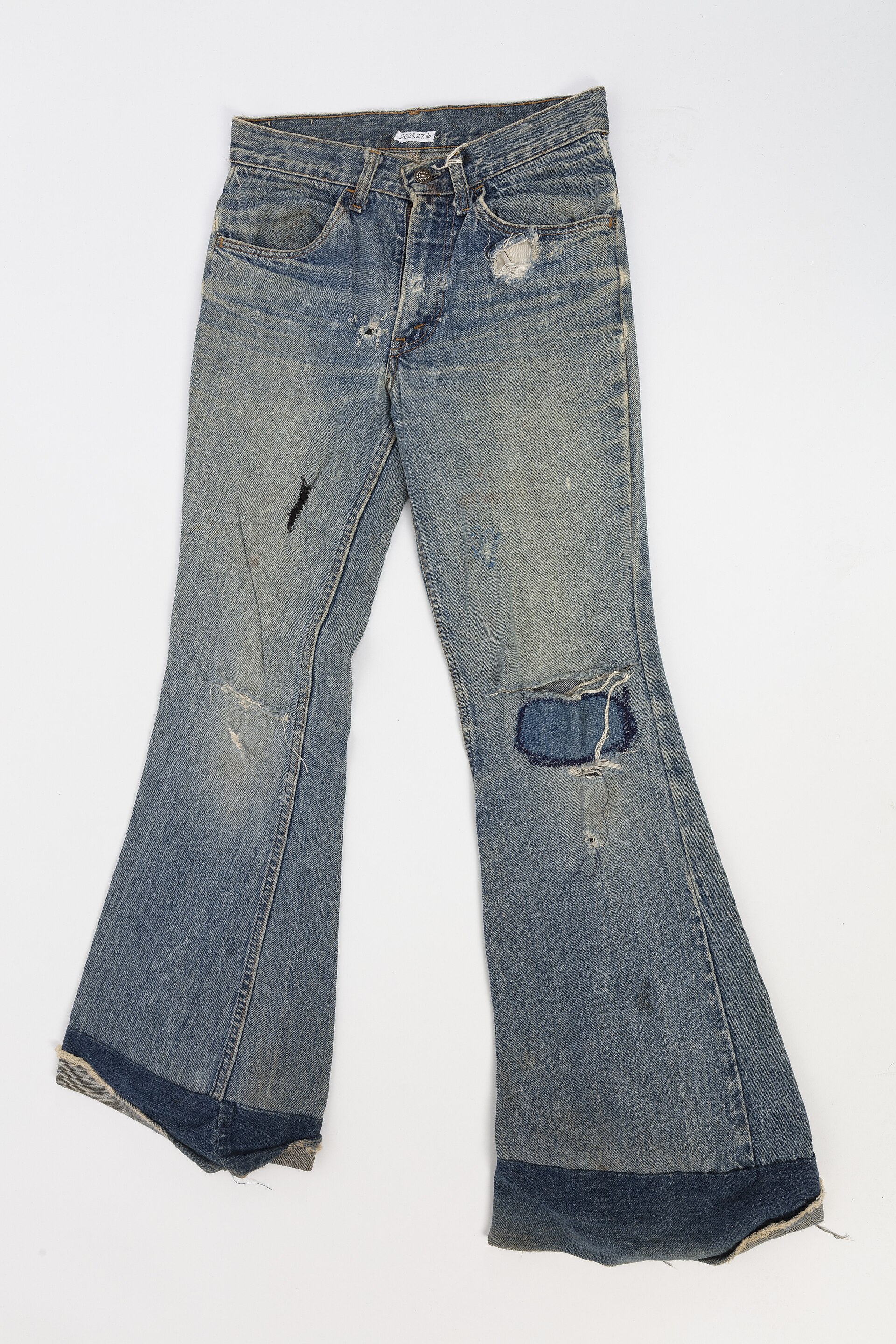
Confirm the Shape, Not Just the Name
Use measurements to separate candidates. Steel Zipper's vintage-retail rule of thumb says classic bells such as Levi's 646 are usually 21 inches or greater around the leg opening for typical 30-38 inch waists, while big or elephant bells are usually over 25 inches. The publisher explicitly calls these cutoffs a generalization, and no universal industry definition was found.
Compare Knee Break, Hem, and Upper-Leg Fit
The silhouette depends on where the leg begins widening and how it fits above that point. Madcap England's current MC249 is slim through the thigh, begins spreading just below the knee, and lists a 24-25 inch flared hem. That is a useful ready-to-wear reference, not a universal elephant-bell specification.
Ask for knee circumference and thigh or hip measurements alongside the hem. A wide opening attached to a fitted thigh reads differently from a baggy upper leg flowing into the same opening. No authoritative universal knee-break position was found, so require a seller-specific measurement or a clear flat photo rather than assuming that “elephant bell” means at or below the knee.
Measure the Garment Consistently
For comparable numbers, measure the bottom edge flat across and multiply by two for hem circumference. Measure the inside leg from the crotch seam to the bottom edge, and the outside leg from the waistband's top edge to the hem. The SAA trouser specification measures knee circumference by folding the hem to the crotch, measuring across 5 cm above the fold, and doubling that width.
Apply the same method to a favorite pair, then compare garment to garment. Hammies tells shoppers to measure a favorite pair flat at the waist and double it; its example turns 16 inches across into a 32-inch waist. This is more useful than trusting a size label without knowing the actual waist construction.
Check Rise, Inseam, Fabric, and Floor Contact
If the goal is a floor-touching hem, wear the intended boots or shoes during the fit check. No trustworthy source in the pack establishes a safe universal amount of floor contact or extra inseam. Footwear, stance, hem construction, and walking conditions vary, so avoid choosing length from a styled photo alone.
Choose Ready-to-Wear, Vintage, or Custom
Custom becomes worth considering when men's sizing does not provide the required combination. In a May 16, 2026 r/doommetal discussion with a visible score of +214, one owner reported supplying fabric, being measured, and paying $50 CAD per pair. WBestWind's current read treats this as one anecdote, not a market price or proof that custom is generally cheaper.
Use a Checkout Spec Sheet
The final decision is dimensional: choose the pair whose measured upper leg, knee break, hem, and length match the intended silhouette and shoes. If a critical measurement is missing, request it or choose a listing with enough information and a workable return path.
Keep a screenshot or written record of the seller's measurements because vintage listings and current inventory can disappear. On arrival, repeat the same flat-garment measurements before removing tags or making alterations, then check the knee break and hem with your intended footwear.
Frequently asked questions
What makes men's elephant bell bottom jeans different from standard bell bottoms?
A vintage retailer uses a leg opening over 25 inches as a general big-bell or elephant-bell rule of thumb, versus 21 inches or greater for classic bells. This is not a universal standard.
How should I measure the hem of men's bell bottom jeans?
Lay the bottom edge flat, measure straight across, and multiply by two to get the hem circumference. Compare only numbers measured with the same method.
Where should the flare begin on bell bottoms for men?
No universal position was found. Madcap's MC249 begins spreading just below the knee, so request the seller's knee measurement and flare-start description.
Can I trust the tagged waist and inseam on vintage jeans?
Use measured dimensions. One Levi's 684 example was tagged 33 x 34 but measured 33 x 33, with a 33-inch inseam and 11.25-inch rise.
Is custom better than ready-to-wear for elephant bells?
Custom may help when ready-to-wear dimensions are unavailable, but the pack does not establish that it is generally cheaper or more practical. The $50 CAD figure is one owner's anecdote.
How much should an elephant-bell hem touch the floor?
No safe universal amount was found. Check the inseam with the intended shoes and consider stance, hem construction, and walking conditions.