
Guide
ASTM Men's Flare Jeans Seam Strength Specification Guide
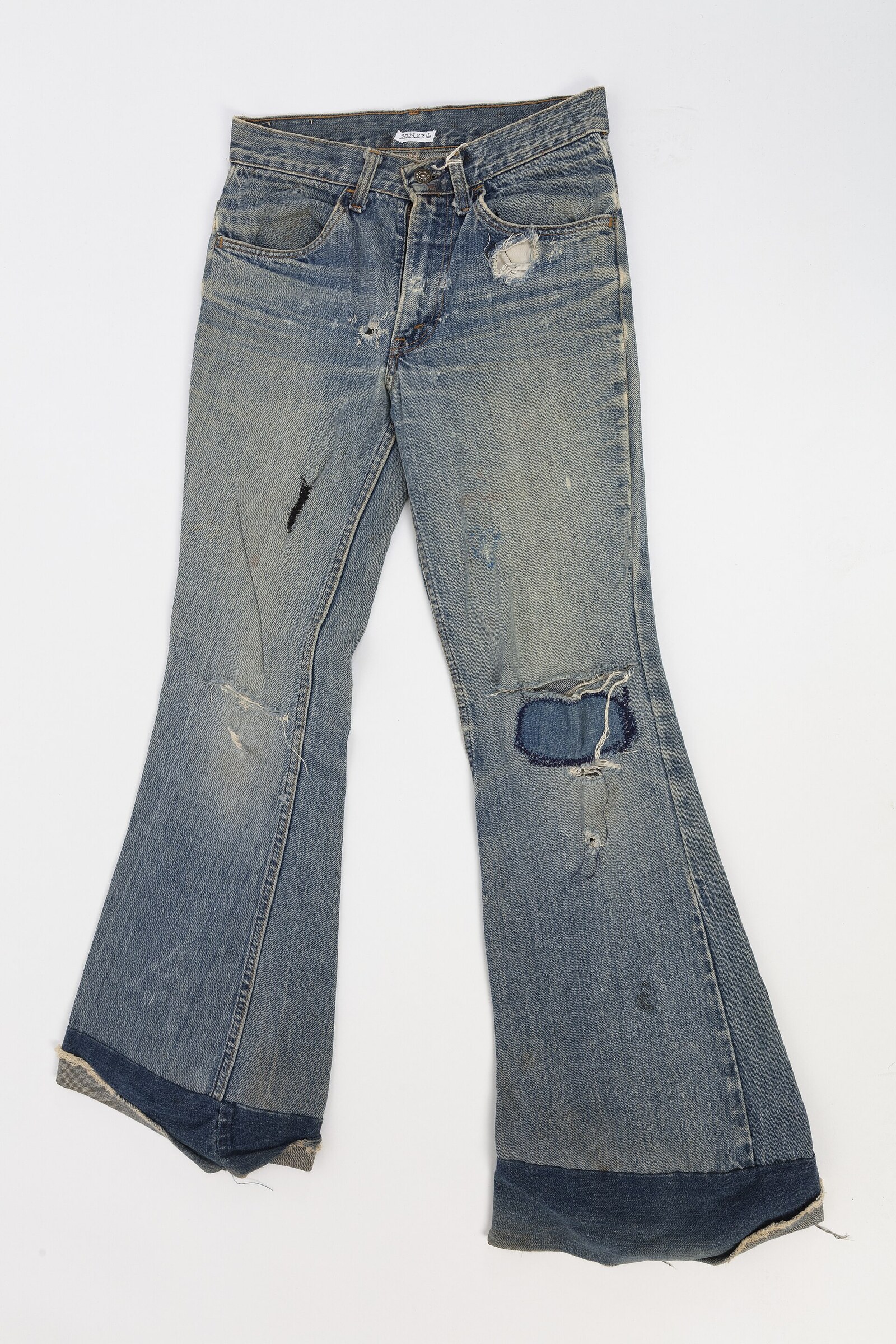
Start With The Test Method
A men's flare jeans seam strength specification guide should start with ASTM D1683/D1683M-22, the pack's public method for failure in sewn seams of woven fabrics. Its metadata lists designation D1683_D1683M-22, Apr. 19, 2022 update, DOI 10.1520/D1683_D1683M-22, and 15 pages.
Use it to ask where failure or seam slippage appeared. D1683 metadata also names thread tex size, seam type, stitch type, stitch density, 13 mm or 0.5 in. seam allowance, Metric 120 needle, and Tex 80 thread for the visible 8-12 oz/yd2 woven range.
Define Seam And Stitch Variables
ASTM D6193-16R25 / ASTM D6193-16(2025) anchors stitch and seam terminology. The pack lists a Nov. 10, 2025 update, DOI 10.1520/D6193-16R25, 142 pages, Section 5 stitch-type classification, and Section 6 seam-type classification.
For men's flare jeans, name stitch class, seam class, SPI, thread tension, and thread strength when visible. Also identify lapped, superimposed, bound, or flat seams; reinforced or heavy duty is too vague without those variables.
Compare Denim Seam Evidence Carefully
Use denim evidence as a benchmark, not a universal rule. A 2025 study tested 100% cotton twill denim at 11 SPI with 891 N fabric strength. Seam strengths ranged from 390 N to 560 N across four seam forms and stitches 301, 401, and 602.
The buyer lesson is direction, not a copied threshold. Use the study only when fabric, seam type, stitch class, and SPI match; do not claim 520 N is always enough or stitch 602 is always right.
Map Checks To Jeans Operations
After the test method and stitch vocabulary, map the spec to jeans operations. The A&E Denim Stitch Matrix lists 301 at typical 8 SPI for pocket-facing, fly, back-pocket, side-seam, band-end, and hem work.
It also lists 401 = 2 for riser, seat, fell inseam, and waistband; 516 for pockets, sideseam, and inseam; and 304 bartack for hip pockets, fly, and belt loops. These are operation examples, not WBestWind product specs.
Check Fly, Crotch, And Tacking Stress Points
Check fly stress-point placement. Coats sets bottom stop to bottom bartack at no more than 0.5 cm, and bottom bartack to J-stitch safety bartack at minimum 2 cm.
A correct bartack normally gives 3-4 times higher protection strength than zip teeth and the bottom stop, while heavy industrial wash loading can exceed domestic washing by more than 100 times. Wrangler's public bootcut claims do not prove WBestWind stress-point construction, cycle counts, or post-wash retention.
Read Flare Openings Without Overclaiming
The flare opening is a fit clue, not a strength result. American Eagle lists 23 in. and 24 in. men's flare openings; Wrangler's relaxed bootcut lists an 18 1/2 in. opening, 11 in. rise, 99% cotton/1% spandex, and 11.5 oz material weight.
Use those specs to prompt hem, outseam, inseam, and wash-stress checks, not to prove extra load versus straight-leg or bootcut jeans. For WBestWind, ASTM D1683 reports, seam slippage data, stitch classes, thread Tex, needle size, stitch density, seam allowance, bartack cycle counts, and post-wash retention targets are (not visible).
Frequently asked questions
What should buyers check first in a men's flare jeans seam strength specification guide?
Check whether the guide names ASTM D1683 testing, ASTM D6193 stitch and seam terms, stitch density, thread and needle specs, seam allowance, and garment stress points.
Does ASTM D1683 give a universal pass/fail number for men's flare jeans?
No public pass/fail thresholds by crotch, inseam, outseam, fly, pocket, waistband, belt loop, or widened hem are visible in the pack.
Which denim seam evidence is useful for flare jeans men compare?
The 2025 denim study is useful because stitch class and seam type changed results at 11 SPI, but it tested only one 100% cotton twill denim fabric.
Why do fly bartacks matter in mens flare jeans?
Coats ties fly bartack placement to zipper protection during washing and wearer movement, with concrete spacing checks of 0.5 cm and 2 cm.
Does a 23 in. or 24 in. flare opening prove weaker seams?
No. The pack shows those openings as public fit benchmarks, but no trustworthy source quantifies extra seam load versus straight-leg or bootcut jeans.
What WBestWind seam specs are visible?
WBestWind ASTM D1683 reports, seam slippage data, stitch classes, thread Tex, needle size, seam allowance, bartack cycles, and post-wash retention targets are (not visible).
Sources
- D1683/D1683M Standard Test Method for Failure in Sewn Seams of Woven Fabrics
- D6193 Standard Practice for Stitches and Seams
- Impact of Various Stitch Classes and Seam Types on Seam Strength
- Denim Stitch Matrix
- Zip Failures: Fly Bartack
- AE AirFlex+ Slim Flare Jean
- AE Baggy Flare Jean
- Men's Wrangler Retro Peak Comfort Relaxed Bootcut Jean